Small-diameter metal components are widely used in industries where compact dimensions, accurate assembly, and consistent performance are essential. However, thin bars, tubes, and wires can easily bend or develop slight curvature during cold drawing, coiling, transportation, heat treatment, or material handling.
Even a small deviation in straightness may cause feeding problems, unstable machining, dimensional variation, or assembly difficulties. For manufacturers processing materials as small as Ø2.3 mm, straightening is therefore not merely a cosmetic operation. It is an important step in maintaining process stability and final product quality.
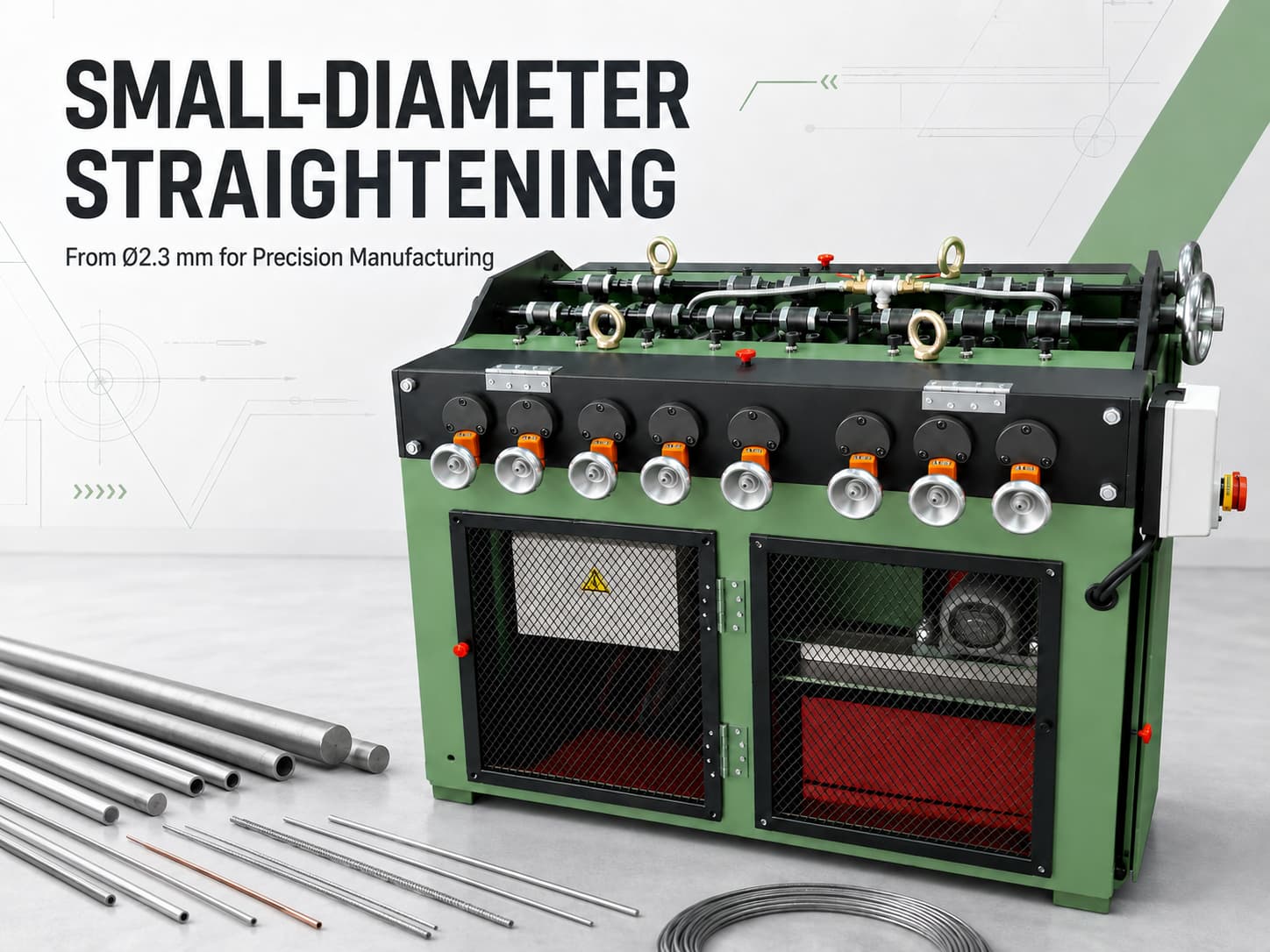
The HOREN INDUSTRIAL CO., LTD. ST0217 Multi-Roller Shaft Straightening Machine is designed for small-diameter metal materials ranging from Ø2.3 to Ø6 mm. Its horizontal multi-roller arrangement provides a practical straightening solution for precision manufacturing applications involving small tubes, bars, rods, and wires.
Why Is Small-Diameter Material Difficult to Straighten?
Straightening a large and rigid bar is different from processing a thin tube or wire. Small-diameter workpieces have less resistance to bending and can be affected by relatively minor changes in handling, roller pressure, or feeding conditions.
Common challenges include:
- Excessive roller pressure that deforms the material
- Insufficient correction of curvature
- Surface marks caused by unsuitable roller settings
- Inconsistent straightness along the material length
- Tube ovality or wall deformation
- Unstable feeding into downstream equipment
The required machine setup also varies according to the material’s diameter, hardness, wall thickness, cross-sectional form, and initial curvature. A suitable straightening system must therefore provide controlled, repeatable adjustment instead of relying on excessive force.
How Does a Multi-Roller Straightening Machine Work?
A multi-roller straightening machine guides the workpiece through a series of rollers arranged in a staggered or zigzag configuration. As the material passes between the rollers, it is repeatedly bent in controlled directions.
These small and progressive corrections redistribute residual stress and reduce curvature along the material length. Compared with attempting to straighten the workpiece through one large correction, the multi-roller approach applies the adjustment gradually.
This is especially useful for small-diameter materials because it can provide:
- More controlled correction
- Stable material guidance
- Reduced dependence on manual straightening
- Repeatable processing conditions
- Better preparation for subsequent machining or assembly
The objective is not simply to make the material appear straight. The straightened workpiece must also feed, rotate, cut, machine, or assemble consistently in the next production stage.
Straightening Materials from Ø2.3 mm
The ST0217 is designed for an applicable size range of Ø2.3 to Ø6 mm. According to its published specifications, the machine uses Ø48 × 40 mm rollers, a 2 HP motor, and a horizontal multi-roller zigzag arrangement. Its listed working range is straightness of ≤0.30 mm per meter.
Actual results may vary according to the material, dimensions, incoming condition, and machine setup.
| Item | ST0217 Specification |
|---|---|
| Applicable size | Ø2.3–Ø6 mm |
| Roller size | Ø48 mm × 40 mm L |
| Motor | 2 HP |
| Machine arrangement | Horizontal multi-roller zigzag |
| Published working range | Straightness ≤0.30 mm/m |
| Main applicable forms | Small tubes, bars, rods, and wires |
| Primary listed materials | Brass and aluminum |
| Control | Inverter speed control/digital control model |
Material compatibility should be confirmed according to the specific alloy, hardness, tube wall thickness, surface requirements, and incoming straightness. A machine that can accommodate the correct diameter does not automatically guarantee that every material within that diameter range can use the same roller configuration or settings.
Applications in Precision Manufacturing
Small-diameter bars, tubes, rods, and wires are used across many precision manufacturing sectors. Although the final products differ, straightening serves a similar purpose: creating stable material conditions for feeding, cutting, machining, forming, inspection, and assembly.
| Application | Why Straightness Matters | Typical Downstream Processes or Components |
|---|---|---|
| Precision Metal Tubes | Small-diameter tubes must remain sufficiently straight for accurate insertion, joining, positioning, and processing. Thin-walled tubes require controlled roller pressure to avoid surface damage, ovality, or wall deformation. | Precision cutting, end forming, bending, surface finishing, connector assembly, inspection, and packaging |
| Small Bars and Rods | Curved bars and rods may feed inconsistently or rotate unevenly during machining. Improved straightness supports stable feeding, reduces vibration and runout, and makes dimensional inspection more reliable. | Pins, shafts, fasteners, connectors, precision-turned parts, CNC turning, cutting, and assembly |
| Precision Wire Processing | Wire may retain curvature or coil memory after storage. Straightening helps stabilize the material before automated feeding, forming, cutting, or insertion. Settings should be adjusted for soft, spring-like, coated, polished, or surface-sensitive wire. | Fixed-length cutting, terminal production, connector pins, wire forming, small mechanical components, and automated insertion |
| Electrical and Electronic Equipment | Electrical and electronic parts often require accurate positioning. Even slight curvature may interfere with automated insertion, alignment, inspection, or continuous production. | Electrical connectors, terminals, contact pins, sensor components, conductive parts, and compact electronic assemblies |
| Precision Automotive Components | Small tubes, rods, and wires used in automotive systems require stable geometry for reliable forming, machining, and installation. Straightening can also serve as an intermediate process between cold drawing and cutting. | Electrical systems, control mechanisms, sensors, connectors, compact assemblies, machining, and final installation |
| Aerospace and Instrumentation Components | These applications often involve small parts with strict dimensional and surface requirements. Straightening creates more stable conditions for subsequent manufacturing, although final accuracy also depends on machining and process control. Special alloys and thin-walled tubes should be verified through application testing. | Measuring instruments, aerospace assemblies, sensing components, precision machining, inspection, and specialized alloy processing |
Why Straightening Should Be Integrated into the Production Process
Straightening is most effective when considered part of the complete production sequence rather than an isolated finishing step.
A typical process may include:
- Material preparation
- Swaging or pointing
- Cold drawing
- Heat treatment when required
- Straightening
- Cutting or machining
- Inspection
- Packaging or assembly
Cold drawing can improve dimensional control and surface finish, but residual stress or handling may still leave the material with curvature. Straightening after drawing helps prepare it for cutting, machining, and inspection.
For automated production, stable straightness also helps the material enter guides, feeders, cutting units, and other downstream equipment more consistently.
Key Benefits of Multi-Roller Straightening
Consistent Material Feeding
Straighter material is easier to guide through automatic feeders, cutting machines, lathes, and assembly equipment. This can reduce interruptions caused by misalignment or irregular movement.
Better Downstream Machining Stability
Curved bars or rods may create runout or vibration when rotating. Improving incoming straightness provides more stable conditions for cutting and turning operations.
Reduced Manual Correction
Manual straightening depends heavily on operator experience and may produce inconsistent results. A properly adjusted multi-roller machine provides a more repeatable process.
Flexible Adjustment
Inverter-controlled speed adjustment and roller-position references allow operators to establish suitable settings for different material sizes and conditions.
Support for Production Automation
A straightening machine can be integrated with feeding, cutting, cold drawing, and packaging equipment. This makes it suitable for manufacturers seeking to improve production continuity and reduce manual material handling.
Factors to Confirm Before Selecting a Straightening Machine
Diameter is important, but it should not be the only selection criterion. Manufacturers should provide the following information when evaluating a machine:
| Evaluation Factor | Why It Matters |
|---|---|
| Material type and grade | Different materials respond differently to repeated bending |
| Outside diameter | Determines whether the material fits the machine’s operating range |
| Tube wall thickness | Thin walls may require gentler correction |
| Material form | Tubes, solid bars, rods, and wires require different considerations |
| Incoming curvature | Affects the amount of correction needed |
| Required straightness | Determines whether the machine can meet the production target |
| Surface requirements | Important for polished, coated, or appearance-sensitive materials |
| Production speed | Influences machine configuration and automation planning |
| Upstream and downstream processes | Determines how the straightener should be integrated |
Providing sample materials and target specifications can help the machine manufacturer evaluate roller settings, line configuration, and process feasibility more accurately.
FAQ
What Is the Minimum Material Diameter Supported by the ST0217?
The published applicable size range is Ø2.3 to Ø6 mm, making the machine suitable for small-diameter metal materials.
What Materials Can the ST0217 Straighten?
The main specification lists small brass and aluminum tubes and wires. Because performance can vary with alloy, hardness, dimensions, and initial curvature, manufacturers should confirm their specific material with HOREN INDUSTRIAL before selecting the machine.
Can the Machine Straighten Both Tubes and Solid Materials?
The machine is intended for small tubes, rods, bars, and wires. The appropriate settings and achievable results depend on whether the workpiece is hollow or solid.
Will Straightening Damage a Thin-Walled Tube?
Improper roller pressure may affect tube roundness or surface condition. Suitable roller adjustment, feeding speed, and application testing are therefore essential for thin-walled products.
Where Should Straightening Be Placed in a Cold Drawing Line?
Straightening is commonly performed after cold drawing or heat treatment and before cutting, machining, inspection, or packaging. The most suitable sequence depends on the material and final product requirements.
Conclusion
As precision products become smaller, the straightness of bars, tubes, rods, and wires becomes increasingly important. A slight bend that appears insignificant during material handling can create feeding, machining, inspection, or assembly problems later in production.
The HOREN INDUSTRIAL ST0217 provides a dedicated solution for materials ranging from Ø2.3 to Ø6 mm. Its horizontal multi-roller design, adjustable speed control, and roller-position references support controlled straightening for small-diameter precision manufacturing.
If your production line handles small brass or aluminum tubes, bars, rods, or wires, contact HOREN INDUSTRIAL CO., LTD. to discuss your material dimensions, required straightness, production speed, and downstream processes. The HOREN team can help evaluate a suitable straightening machine or integrated metal-processing solution.
