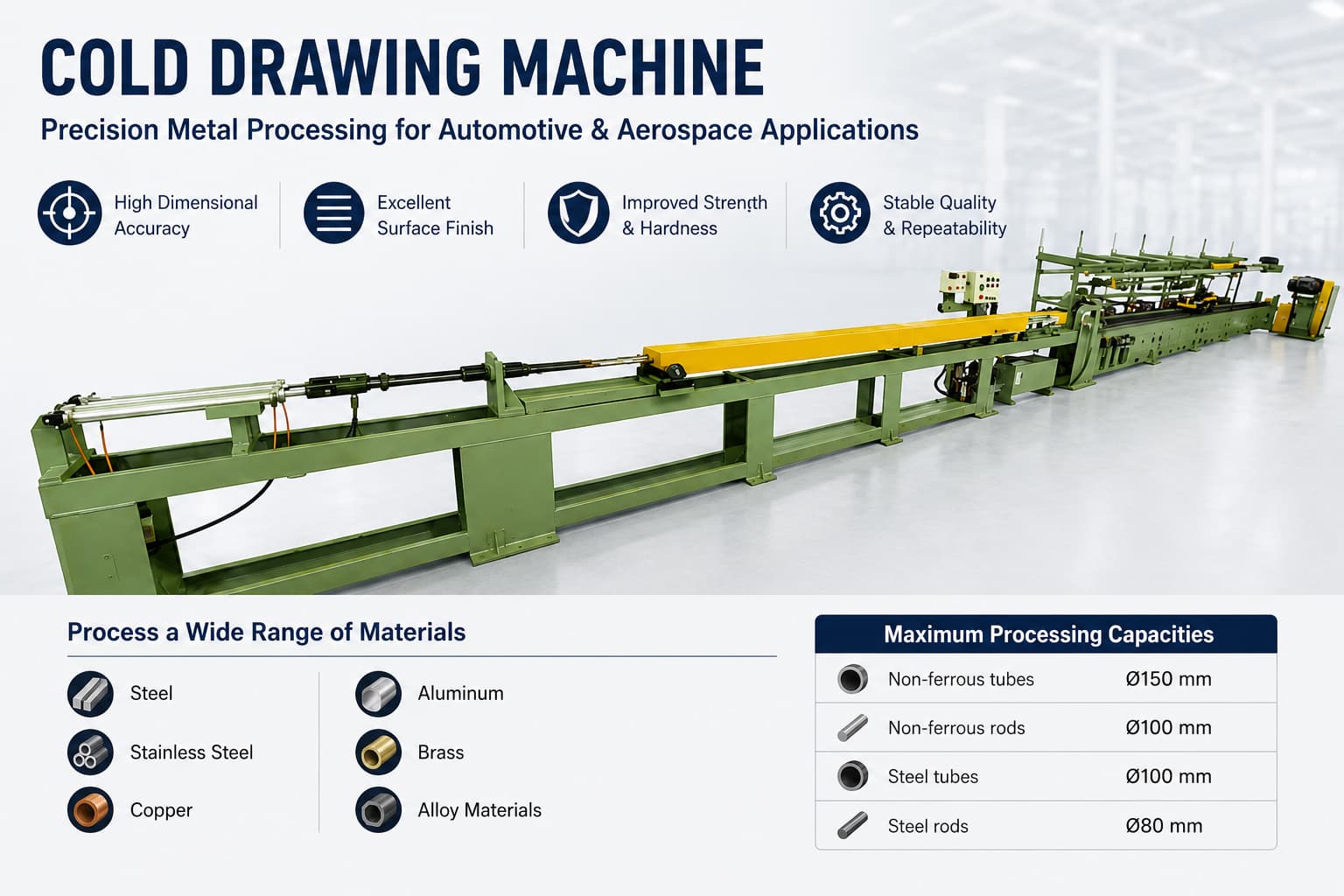
The Importance of Cold Drawing in Automotive and Aerospace Material Processing
Cold drawing is widely used in automotive, aerospace material processing, and other metal manufacturing industries. By drawing bars, tubes, or wires through a die, the process can improve dimensional accuracy and surface finish while potentially creating a work-hardening effect depending on the material and processing conditions.
For many manufacturers, maintaining consistent material quality is essential for subsequent operations such as straightening, heat treatment, cutting, machining, and assembly. As a result, cold drawing is often considered one of the key upstream processes in precision metal manufacturing.
HOREN Cold Drawing Machines
At HOREN INDUSTRIAL CO., LTD., we design and manufacture cold drawing machines for processing metal tubes, bars, and wires. Our product range includes the SA20B, SA30B, SA50B, SA75B, and SA100B models, each designed for different material sizes and production requirements.
For larger material applications, our machines are capable of processing:
- Non-ferrous metal tubes: up to Ø150 mm
- Non-ferrous metal bars: up to Ø100 mm
- Steel tubes: up to Ø100 mm
- Steel bars: up to Ø80 mm
With various model options available, manufacturers can select the most suitable machine according to their production requirements and material specifications.
Why Cold Drawing Matters in Automotive and Aerospace Material Processing
Cold drawing is a metal forming process in which bars, rods, tubes, or wires are pulled through a die to reduce their cross-sectional area while improving dimensional consistency and surface quality.
For automotive and aerospace material suppliers, production requirements often include:
- Consistent dimensions
- Stable cross-sectional profiles
- Improved surface finish
- Reliable downstream processing performance
- Compatibility with subsequent manufacturing processes
For this reason, cold drawing is commonly used as a preparatory process before straightening, heat treatment, cutting, machining, or assembly.
Capabilities of HOREN Cold Drawing Machines
HOREN cold drawing machines are suitable for processing a wide range of materials, including:
- Carbon steel
- Stainless steel
- Copper
- Aluminum
- Brass
- Alloy materials
The machines can also accommodate various material profiles, including:
- Round bars
- Square bars
- Hexagonal bars
- Selected custom profiles
This flexibility allows manufacturers to process different materials and product shapes using the same production line.
In addition, different machine models are designed to accommodate varying material sizes and production capacities. Smaller models are suitable for lighter-duty applications, while larger models can process bigger diameters and higher-strength materials.
Applications in the Automotive Industry
In automotive material processing, cold drawing is commonly used for:
- Automotive bars and tubes
- Metal tubing for fluid systems
- Structural materials for further processing
- Materials requiring subsequent straightening or heat treatment
Cold drawing helps improve dimensional consistency and surface quality before materials enter downstream manufacturing processes.
In many production environments, drawn materials are subsequently processed through:
- Straightening
- Heat treatment
- Cutting
- Machining
- Assembly
As a result, the quality of the cold drawing process can directly influence downstream production efficiency and consistency.
Applications in Aerospace Material Processing
Aerospace material suppliers often require high standards of dimensional consistency and surface quality. Tubes, rods, and bars intended for aerospace-related applications typically require stable dimensions and material quality before entering subsequent manufacturing processes.
Cold drawing can help achieve:
- Improved dimensional control
- Better surface finish
- Potential work-hardening effects depending on the material
- More consistent batch-to-batch quality
These characteristics are particularly valuable when materials undergo precision machining, assembly, or other high-specification manufacturing processes.
Because HOREN cold drawing machines can process carbon steel, stainless steel, copper, aluminum, brass, and alloy materials, they are suitable for a variety of aerospace material processing applications. The ability to process round, square, hexagonal, and selected custom profiles also provides manufacturers with greater flexibility in material selection.
Why Machine Selection Matters
Different cold drawing applications require different machine configurations. Material type, incoming material size, finished dimensions, and production volume all influence the most suitable machine selection.
When evaluating a cold drawing machine, manufacturers typically consider:
- Material type
- Profile shape
- Material size range
- Production requirements
- Downstream manufacturing processes
HOREN offers multiple machine models to help manufacturers select equipment that best matches their production needs while maintaining stable processing performance.
Key Considerations When Selecting a Cold Drawing Machine
In addition to machine specifications, manufacturers often evaluate several important factors before investing in a cold drawing system.
Material Compatibility
The machine should be capable of processing various materials, including carbon steel, stainless steel, copper, aluminum, brass, and other alloys.
Profile Flexibility
Besides round bars, many applications require square, hexagonal, or custom-shaped profiles. Equipment capable of handling different profile shapes provides greater manufacturing flexibility.
Drawbench Stability
A stable drawbench system helps maintain dimensional consistency and surface quality throughout the drawing process.
Automation Options
Automatic loading, feeding, and unloading systems can increase productivity while reducing labor requirements and process variation.
Production Line Integration
Cold drawing is often combined with straightening, heat treatment, cutting, and machining operations. Equipment that can be easily integrated into existing production lines can improve overall manufacturing efficiency.
Why Cold Drawing Continues to Be Widely Used
In addition to changing material dimensions, cold drawing can improve dimensional accuracy and surface finish while potentially creating a work-hardening effect depending on the material and processing conditions.
As a result, cold drawing is widely used in:
- Automotive material processing
- Aerospace material processing
- Construction materials
- Metal manufacturing
- General industrial manufacturing
For materials that require subsequent straightening, heat treatment, or machining, cold drawing often serves as an important upstream process.
Conclusion
Cold drawing is widely used in automotive, aerospace, and other metal manufacturing industries because it helps improve dimensional accuracy and surface finish while potentially generating work-hardening effects depending on the material and processing conditions.
HOREN INDUSTRIAL offers a range of cold drawing machine models designed to accommodate different material sizes and production requirements. Our machines are suitable for processing carbon steel, stainless steel, copper, aluminum, brass, and alloy materials, and can handle round, square, hexagonal, and selected custom profiles to meet diverse manufacturing needs.
FAQ
1. Why is cold drawing widely used in automotive and aerospace material processing?
Cold drawing helps improve dimensional accuracy and surface finish and may produce work-hardening effects depending on the material and processing conditions. These characteristics are beneficial for subsequent manufacturing operations and assembly processes.
2. What materials can HOREN cold drawing machines process?
HOREN cold drawing machines are suitable for processing carbon steel, stainless steel, copper, aluminum, brass, and various alloy materials.
3. What do model numbers such as SA20B, SA30B, and SA100B represent?
These model numbers represent different motor capacities and applicable material size ranges, allowing manufacturers to select the most suitable machine according to production requirements.
4. What is the maximum processing capacity of HOREN cold drawing machines?
Maximum processing capacities include:
- Non-ferrous metal tubes: up to Ø150 mm
- Non-ferrous metal bars: up to Ø100 mm
- Steel tubes: up to Ø100 mm
- Steel bars: up to Ø80 mm
5. Can cold drawing be integrated with other manufacturing processes?
Yes. Cold drawing is commonly integrated with straightening, heat treatment, cutting, and machining processes and often serves as an important preparation step in metal manufacturing.
Contact Us
If you are looking for a cold drawing solution for automotive, aerospace, or other precision metal processing applications, HOREN INDUSTRIAL can help evaluate the most suitable machine based on your material specifications, product dimensions, and production requirements.
Contact us today to learn how our cold drawing machines can support your manufacturing process.
