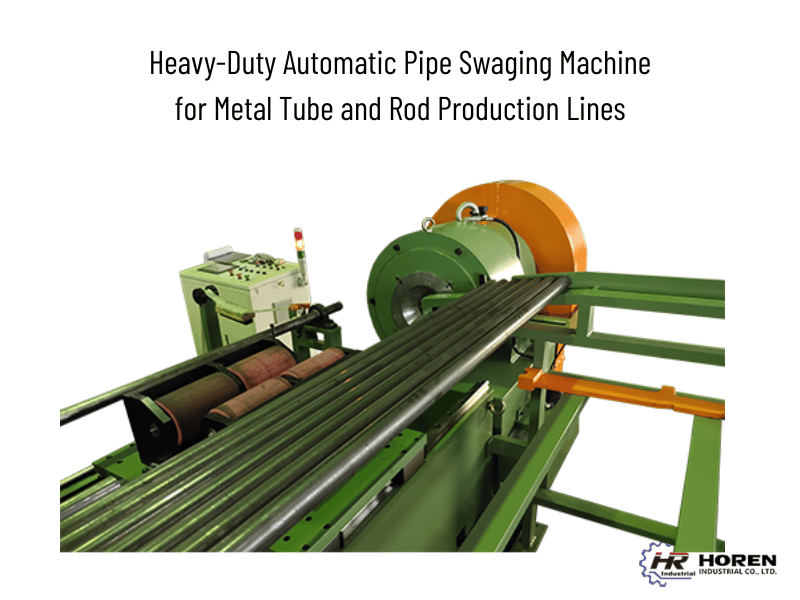
In metal tube and rod processing, end forming is often a necessary step before further deformation, assembly, or dimensional refinement. When the workpiece requires a reduced end, tapered section, or beveled geometry, a heavy-duty automatic pipe swaging machine provides a controlled forming method that can be integrated into industrial production lines. For manufacturers processing brass, aluminum, carbon steel, and alloy materials, this type of equipment is especially relevant in applications where forming stability, repeatability, and compatibility with downstream operations are required. In such cases, the swaging process is not an isolated operation, but part of a broader production sequence.
At HOREN INDUSTRIAL CO., LTD., we focus on cold working process equipment for metal tubes and bars. Our product range includes swaging machines, pointing machines, cold drawbenches, taper forming machines, straightening machines, and related metalworking equipment. The company was established in 2008 and grew from Ho Sing Machine, which was originally registered in 1987. Based in Dajia Youth Industrial Park, Taichung, Taiwan, we support manufacturers with both individual machines and turn-key solutions for precise metal tube and bar processing.
Machine Overview
The following specifications describe the capabilities of this heavy-duty automatic pipe swaging machine:
| Item | Specification |
|---|---|
| Machine Type | Heavy-Duty Automatic Pipe Swaging Machine |
| Material | Brass, Aluminum, Carbon Steel, Alloy |
| Material Form | Tubes, Rods, Wires |
| Material Size Range | Non-ferrous tubes Ø30–Ø90 mm; Non-ferrous rods Ø30–Ø75 mm; Steel tubes Ø30–Ø80 mm; Steel rods Ø30–Ø60 mm |
| Working Range | Tube diameter 8–15 mm; Rod diameter 3–8 mm |
| Motor | 30 HP × 6P |
| Main Features | Strong power output, hydraulic feeding system, precision forming capability, taper/bevel end forming, automation-ready design |
| Main Applications | Cold drawing pre-processing, taper/bevel end forming, industrial tube and thin-wall part production |
This machine class is designed for production lines where a stable end-forming process is required before downstream operations such as cold drawing, fitting, machining, or assembly.
Function of an Automatic Pipe Swaging Machine
An automatic pipe swaging machine reshapes the end of a tube, rod, or wire by applying compressive forming force to reduce diameter or create a specific end geometry. In practical production, the process is commonly used for:
- taper end forming
- bevel end forming
- local diameter reduction
- pre-processing before cold drawing
Because the process deforms rather than removes material, it is suitable for applications where material continuity and forming efficiency are important. This is particularly useful when the next process step depends on a stable and repeatable entry geometry.
Relevance in Tube and Rod Production Lines
In many production lines, the swaging operation serves as a preparation step rather than a final step. Before a bar or tube enters a drawing die, the workpiece end often needs to be reduced to allow smooth die entry and stable gripping. Without this preparation, drawing may become less stable and the risk of tool wear or process variation can increase.
In this context, an automatic pipe swaging machine supports the overall line by improving:
- workpiece entry condition
- dimensional consistency at the formed end
- repeatability of subsequent operations
- production flow between forming stages
This is why swaging is frequently positioned upstream of cold drawing and sometimes followed by straightening, depending on the product requirements.
Machine Characteristics Relevant to Production Stability
High-Power Drive System
A 30 HP × 6P motor provides the forming force required for heavy-duty processing. In practical terms, sufficient motor power is important not only for forming harder materials, but also for maintaining process stability during repeated industrial operation. For metal tube and rod production lines, this contributes to stable deformation under load, reduced fluctuation in forming performance, and better suitability for continuous operation.
Hydraulic Feeding System
A hydraulic feeding system improves the consistency of material transfer into the forming zone. Compared with less controlled feeding methods, hydraulic feed motion helps reduce variation caused by inconsistent positioning or unstable entry. This is significant in applications where the end geometry must remain consistent from part to part, especially when the formed section is used in later cold drawing or fitting operations.
Precision Forming Capability
In industrial production, end forming quality is determined not only by nominal machine capacity, but also by the machine’s ability to produce the same geometry repeatedly. Precision forming capability is therefore important when the machine is used for accurate taper end forming, repeatable bevel profiles, controlled reduction lengths, and preparation of semi-finished or finished hardware components.
Automation-Ready Design
For production lines that may later incorporate automatic loading, unloading, or transfer systems, an automation-ready machine structure is beneficial. Even when first installed as a standalone machine, this design makes it easier to integrate the equipment into a more continuous and synchronized line configuration. From a process engineering standpoint, automation readiness improves the machine’s suitability for long-term production planning.
Typical Processing Roles in Manufacturing
A heavy-duty automatic pipe swaging machine is commonly used in three types of production roles.
1. Pre-Processing Before Cold Drawing
One of the most common uses is the preparation of bar or tube ends before cold drawing. The formed end allows smoother passage through the drawing die and improves process stability during pulling.
2. End Forming of Semi-Finished Components
The machine can also be used to create tapered or beveled ends on semi-finished parts before further machining, joining, or assembly.
3. Tube and Thin-Wall Part Production
For industrial tubing, pipes, and selected thin-wall parts, controlled end reduction is often necessary to prepare the workpiece for later fitting, dimensional refinement, or system integration.
Industrial Applications
Because the machine can process multiple materials and support heavy-duty operation, it is relevant in several industries.
| Industry | Typical Application |
|---|---|
| Automotive | Tube and rod end forming before cold drawing, fitting, or assembly |
| Aerospace | Precision taper or bevel end forming on tubes and rods used in high-performance applications |
| Construction | Heavy-duty metal tube and rod processing for selected structural or industrial parts |
| General Manufacturing | End forming of semi-finished hardware parts, industrial tubing, and thin-wall components |
These applications are different in final product, but they share the same process requirement: stable and repeatable end geometry before the next manufacturing step.
Position in the Process Chain
In many manufacturing environments, the swaging machine works as part of a sequence rather than a standalone cell. A common process route is:
Swaging → Cold Drawing → Straightening
In this sequence:
- Swaging prepares the end geometry
- Cold drawing refines size, surface finish, and mechanical properties
- Straightening restores final linearity and geometric accuracy
This broader process perspective is also part of how we approach machine design at HOREN. Because our product line includes swaging machines, cold drawing machines, automatic cold drawing machines, and multi roller straightening machines, we can evaluate the swaging stage not only as an individual process, but as part of a complete metal tube and bar production route.
Key Technical Considerations for Production Line Selection
When evaluating a heavy-duty automatic pipe swaging machine for tube and rod production, several technical factors are more significant than nominal power alone:
- material compatibility with brass, aluminum, carbon steel, and alloy stock
- capacity range between incoming material diameter and final formed section
- feed stability provided by the hydraulic system
- repeatability of taper and bevel geometry
- integration potential with drawing, transfer, or unloading systems
- suitability for downstream operations such as cold drawing or assembly
These factors determine whether the machine can perform reliably under real production conditions over extended operating cycles.
Conclusion
A heavy-duty automatic pipe swaging machine is an important forming solution in metal tube and rod production lines where end reduction, tapering, or bevel forming must be carried out with consistency and process stability.
Its technical value lies not only in its forming force, but in its role within the broader production sequence. When used for cold drawing pre-processing, end forming of semi-finished parts, or industrial tube production, the machine supports better workflow continuity and more stable downstream processing.
At HOREN INDUSTRIAL CO., LTD., our long-term focus on cold working process equipment for metal tubes and bars shapes how we develop these machines. With experience spanning swaging, drawing, taper forming, and straightening equipment, we approach the automatic pipe swaging machine as part of a complete engineering solution for precision manufacturing.
Contact Us
If your production line requires stable and repeatable tube or rod end forming before cold drawing, machining, or assembly, HOREN INDUSTRIAL CO., LTD. can help you evaluate the right solution based on your material type, forming range, and production requirements. Contact us to discuss how our automatic pipe swaging machines and related metal forming equipment can support your manufacturing process.
