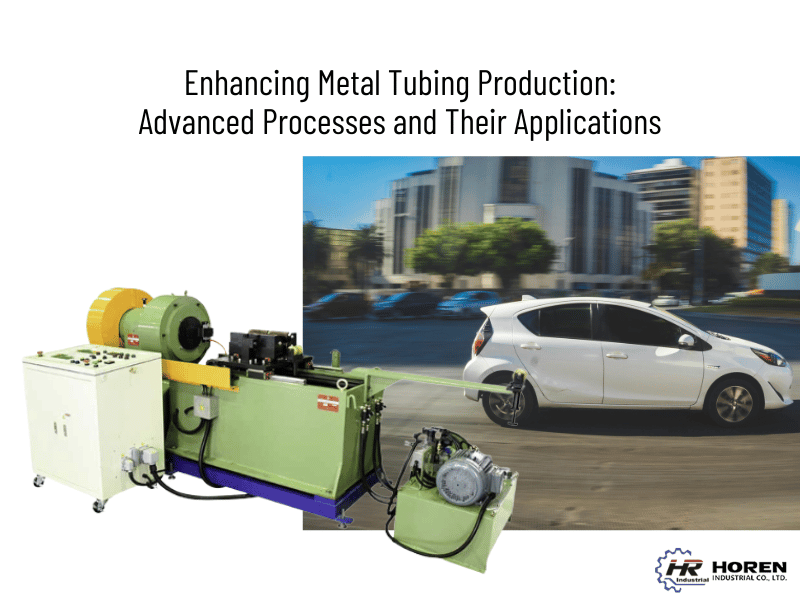
In automotive manufacturing, tubular parts have to do more than simply fit a drawing. They often need to transmit torque, withstand vibration, handle pressure, reduce weight, and remain dimensionally stable over long service life. That is why tube swaging continues to play an important role in modern vehicle production. Rotary swaging is a cold-forming process that reshapes tube or round material by rapid radial blows, and it is widely used for reducing, sizing, tapering, and forming tube without cutting away material.
At HOREN INDUSTRIAL CO., LTD., we focus on cold working process equipment for metal tubes and bars. Our product range includes Swaging Machines, Pointing Machines, Cold Drawbenches, Taper Forming Machines, Straightening Machines, and related metalworking equipment. The company was established in 2008 and grew from Ho Sing Machine, originally registered in 1987. Based in Dajia Youth Industrial Park, Taichung, Taiwan, we continue to support customers with both individual machines and turn-key solutions for precise metal tube and bar processing.
From our perspective, automotive applications are one of the strongest use cases for tube swaging because manufacturers in this industry must balance precision, productivity, material efficiency, and part performance at the same time.
Why Tube Swaging Matters in Automotive Manufacturing
Tube swaging is especially useful when a manufacturer needs to change diameter, create a tapered section, improve local strength through cold working, or prepare a tube end for a connection or later forming step. Because the process reshapes the material instead of removing it, it can preserve material continuity while improving the workpiece geometry for the next operation.
In automotive production, this matters because many tubular components are not just passive pipes. They are structural or functional parts that must perform under repeated load, vibration, and motion. Depending on the application, tube swaging can help manufacturers achieve:
- Controlled end reduction
- Tapered sections
- Better fit for mating parts
- Improved material utilization
- Pre-formed geometry for downstream cold drawing or assembly
These advantages make tube swaging highly relevant when the production goal is both precision and efficiency.
Typical Automotive Parts That Can Use Tube Swaging
Tube swaging is commonly associated with automotive components that require local diameter changes or controlled end forming rather than full-length reshaping.
Examples include:
- Drive shafts
- Steering-related tubular parts
- Crash-management tubes
- Selected fuel or fluid system components
- Hollow shafts and connecting tubular parts
- Tube ends prepared for later precision drawing or joining
In these kinds of parts, the manufacturing challenge is often not just “make the tube smaller,” but “make a specific section smaller in a repeatable, production-friendly way.”
That is where swaging has an advantage.
Why Not Just Use Other Forming Processes?
One important technical question is whether automotive manufacturers actually need tube swaging, or whether other forming methods could produce the same result.
The answer is: yes, other processes can also make some of these parts — but each process has different strengths.
1. Tube End Forming / Ram Forming
Tube end forming is often used for expansions, reductions, beading, and flaring. If the geometry is concentrated only at the tube end, this can be an effective method. However, it is usually more limited when a manufacturer needs a stronger cold-worked reduction zone or more gradual tapered shaping.
2. Hydroforming
Hydroforming is well suited to more complex tubular shapes, especially when the part requires broader geometric transformation or structural contouring. For simple local diameter reduction, however, hydroforming may be more complex or costly than necessary.
3. Cold Drawing
Cold drawing is ideal for refining diameter, improving surface finish, and achieving tighter dimensional control over the length of the bar or tube. In many production lines, swaging is used first to prepare the workpiece end so it can pass smoothly through the drawing die. This makes swaging and cold drawing complementary rather than competing processes.
4. Machining or Welded Fabrication
Some parts can be produced by machining solid material down to shape, or by welding multiple pieces together. These methods can work, but they may involve more material waste, more process steps, or greater joining complexity compared with a cold-forming route.
For many automotive parts, the question is not whether other processes exist. The more practical question is:
Which process gives the right balance of cost, geometry, strength, and production speed?
In many cases, tube swaging is chosen because it sits in an effective middle ground between basic end forming and more complex or material-intensive routes.
Why Tube Swaging Is a Strong Choice for Automotive Parts
For automotive manufacturers, tube swaging offers several practical benefits.
Material Efficiency
Because the process forms rather than cuts, manufacturers can reduce waste compared with machining-heavy approaches.
Strength Through Cold Working
The cold-forming nature of swaging can improve material properties in the formed area, which is valuable for parts exposed to cyclic or structural loads.
Good Repeatability
For production environments, repeatability matters as much as precision. Tube swaging machines can provide stable forming performance over repeated cycles.
Suitability for Downstream Processes
Swaged tube ends are often better prepared for drawing, assembly, joining, or further sizing.
Flexibility Across Tubular Automotive Parts
The process can be adapted for multiple tubular component types, especially those requiring local reductions, tapers, or end preparation.
Where HOREN’s Product Range Fits
At HOREN, we do not look at tube swaging as an isolated machine function. We view it as part of a wider metal forming process chain.
Our core business is focused on machining equipment and turn-key solutions for precise metal tubes and bars, and we continuously develop our equipment around automation and innovation. In addition to swaging machines, we also manufacture cold drawing machines and multi roller straightening machines, allowing manufacturers to build a more complete and consistent process route for tube and bar production.
For automotive tube applications, this matters because a typical process may look like:
Tube Swaging → Cold Drawing → Straightening
In this sequence:
- Tube swaging prepares the workpiece end or local geometry
- Cold drawing refines size, mechanical properties, and surface finish
- Straightening restores final geometric accuracy for later machining or assembly
Because we manufacture these related machine types under one company, we are able to support customers not only with individual equipment, but also with a broader production perspective.
Why Automotive Manufacturers May Benefit from a Full Process View
Automotive manufacturers rarely evaluate one part in isolation. They evaluate total production performance:
- Cycle time
- Scrap rate
- Tooling wear
- Operator requirements
- Line integration
- Consistency across batches
This is why choosing a tube swaging machine should not be based only on the forming step itself. It should also consider how the part will move into downstream operations such as drawing, straightening, cutting, machining, or assembly.
From our experience, manufacturers often get the best result when swaging is planned as part of a full production flow rather than as a standalone machine purchase.
FAQ
What automotive parts are suitable for tube swaging?
Tube swaging is suitable for automotive parts that require local diameter reduction, tapered sections, end preparation, or hollow lightweight geometry. Common examples include drive shafts, steering-related tubes, hollow shafts, and selected fluid system components.
Can other processes also produce similar automotive parts?
Yes. Tube end forming, hydroforming, cold drawing, machining, and welded fabrication can also be used depending on the part design. The best process depends on geometry, production volume, material, and cost target.
Why use tube swaging before cold drawing?
Swaging is often used to prepare the end of the workpiece so it can enter the drawing die smoothly. This improves drawing stability, reduces die wear, and helps maintain process consistency.
Is tube swaging only for manual or low-volume production?
No. Tube swaging can be used in production environments where repeatability and throughput are important, especially when integrated into a broader forming line.
Does HOREN only provide swaging machines?
No. We also provide cold drawing machines, automatic cold drawing machines, multi roller straightening machines, and turn-key solutions for precise metal tube and bar processing.
Conclusion
Tube swaging is not the only process available for automotive tube components, but it is one of the most practical when the requirement involves local reduction, tapering, entry preparation for drawing, or efficient cold-formed shaping without unnecessary material removal.
At HOREN INDUSTRIAL CO., LTD., we support manufacturers with a broader metal forming perspective. Our experience in swaging, cold drawing, and straightening equipment allows us to help customers evaluate not only what machine they need, but also how that machine should fit into the full production sequence. Established in 2008 and built on the foundation of Ho Sing Machine since 1987, we continue to focus on precision machinery and turn-key solutions for metal tube and bar processing.
If your company is evaluating tube forming solutions for automotive production, we welcome the opportunity to discuss your material, part geometry, and production goals in more detail.
Call to Action
If you are looking for a more efficient way to form automotive tubes, reduce material waste, and improve production consistency, contact HOREN INDUSTRIAL CO., LTD. to discuss your application.
We provide:
- Swaging machines
- Cold drawing machines
- Automatic cold drawing machines
- Multi roller straightening machines
- Turn-key solutions for precise metal tube and bar production
Explore our machinery and solutions through our website, or reach us directly:
HOREN INDUSTRIAL CO., LTD.
No. 2, Dongsan St., Dajia Youth Industrial Park, Taichung City 437, Taiwan
Tel: +886-4-26817377
