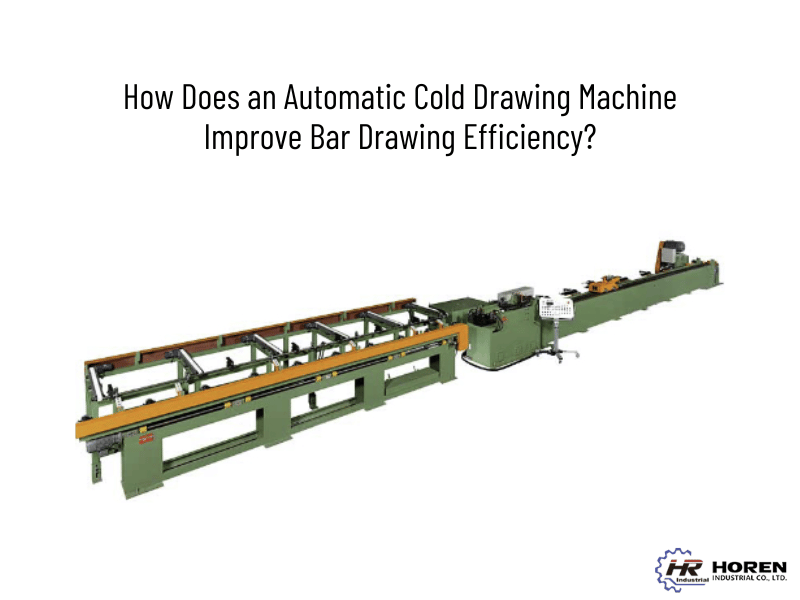
In metal fabrication, cold drawing is a fundamental process used to produce bars with precise dimensions, improved mechanical properties, and fine surface finish. Traditionally, cold drawing relied heavily on manual labor and multiple individual steps—often resulting in slower cycle times, higher labor costs, and inconsistent quality. However, the advent of Automatic Cold Drawing Machines has dramatically changed this landscape by significantly increasing efficiency, consistency, and throughput.
In this article, we explore how an automatic cold drawing machine enhances production efficiency, reduces operational costs, and optimizes workflows—especially for high-volume industrial environments.
Understanding the Challenges of Traditional Cold Drawing
Before diving into the benefits of automation, it’s important to recognize the limitations of traditional cold drawing lines:
-
Manual Material Handling
Operators were often responsible for loading, feeding, straightening, and unloading workpieces. This step-by-step involvement increased cycle time and introduced human error.
-
Separate Forming Steps
Processes such as swaging (to prepare ends), drawing through dies, and resetting between passes all required manual intervention or multiple machines.
-
Inconsistent Timing
Different operators could deviate in speed, force application, and feed rate, leading to variation in tensile strength, diameter, and surface quality among products.
-
Higher Labor Costs
Manufacturers needed skilled labor for repetitive tasks—especially when dealing with harder materials like stainless steel or alloy steels.
These challenges set the stage for more advanced, automated solutions.
Enter Automatic Cold Drawing Machines
The Automatic Cold Drawing Machine—such as the HS model series from Horen Industrial Co., Ltd.—is designed to solve these inefficiencies. It combines multiple stages of the drawing process into a single, cohesive, PLC-controlled production line.
Key features of the HS series include:
- Chain-type automatic feeding system
- Hydraulically powered extrusion (push pointer)
- Integrated loading and discharging arms
- PLC control for complete process coordination
- Capability to handle round, hexagonal, and square bars
For detailed specifications and the full equipment lineup, see:
https://www.horenco.com/en/products
How Automation Improves Efficiency
1. Seamless Material Flow with Automatic Loading and Feeding
The HS automatic cold drawing machine integrates a loading machine and feeding system that take material from initial stock and present it to the drawing bench in a controlled, repeatable manner. This eliminates manual handling and shortens cycle time per part—especially in medium to high volume production.
This continuous feed approach prevents bottlenecks between drawing passes and ensures operators can monitor multiple machines or processes simultaneously.
2. Hydraulic Push Pointer Eliminates Manual Swaging
Instead of using manual or secondary swaging to prepare the bar ends, the HS model uses a hydraulically powered push pointer (also known as a “hydraulic extrusion unit”) to clamp the workpiece and push it directly into the die.
This has several efficiency benefits:
- Faster die engagement
- Reduced tool setup time
- Consistent force application
- Less workpiece re-handling
Overall, this replaces multiple manual steps with a single, automated action—drastically reducing per-piece cycle time.
3. PLC-Controlled Process Synchronization
Modern automatic cold drawing machines use PLC (Programmable Logic Controller) automation to coordinate every stage of the process—from loading and drawing to unloading:
- Automatic speed control (inverter-based adjustment)
- Systematic pressure control
- Feedback monitoring for material position
- Synchronized unloading arms
This synchronization eliminates idle time between operations, enables faster throughput, and ensures consistent quality from part to part.
4. Automatic Unloading Arms for Continuous Operation
Once a workpiece is drawn and has satisfied dimensional criteria, automatic unloading arms place the finished bar on a designated rack or conveyor.
Benefits include:
- No manual part removal
- Reduced cycle time
- Lower labor cost
- Improved safety (less operator interaction with moving dies)
By automating unloading, the machine is ready to start the next cycle immediately—eliminating worker wait times.
5. Reduced Human Error and Enhanced Product Consistency
Automating each phase—loading, drawing, pushing, and unloading—removes many of the variables introduced by manual operation. With every cycle controlled by PLC and repeatable mechanical motion, automatic cold drawing delivers:
- Tighter tolerance bands
- Consistent surface finish
- Fewer rejects
- Enhanced material properties
This is especially important in industries where product uniformity directly impacts downstream operations, such as machining or assembly.
Industry Applications Where Efficiency Matters Most
Automatic cold drawing machines improve production efficiency across multiple sectors:
- Automotive: Production of drive shafts, tie rods, and precision bars with consistent mechanical properties.
- Medical Device Manufacturing: Drawing small-diameter tubes and rods for implants or surgical tools with tight tolerances.
- Aerospace: High-strength alloys requiring repeatable performance across batches.
- Industrial & Machinery: Structural components and power transmission rods with predictable dimensional performance.
Real-World ROI: Efficiency Gains in Action
Companies that implement automatic cold drawing solutions typically report improvements such as:
- 30%–50% faster throughput
- Lower labor cost per unit
- Reduced scrap rate (often < 5% when parameters are stabilized)
- Improved die life due to uniform forming
- Less downtime between shifts
These gains are especially pronounced when comparing automatic systems to manually operated drawing lines with intermediate handling.
Conclusion
For manufacturers seeking to boost efficiency, reduce cycle time, and improve product consistency, the adoption of an Automatic Cold Drawing Machine represents a smart strategic investment. The key benefits—automatic loading, PLC-synchronized forming, hydraulic extrusion, and automated unloading—combine to streamline the cold drawing process in ways that traditional systems simply cannot match.
If your production line handles large volumes of metal bars, rods, or tubes and you’re aiming for higher throughput and lower costs, consider integrating an automatic cold drawing solution based on your specific material and tolerance requirements. Explore suitable models here:
